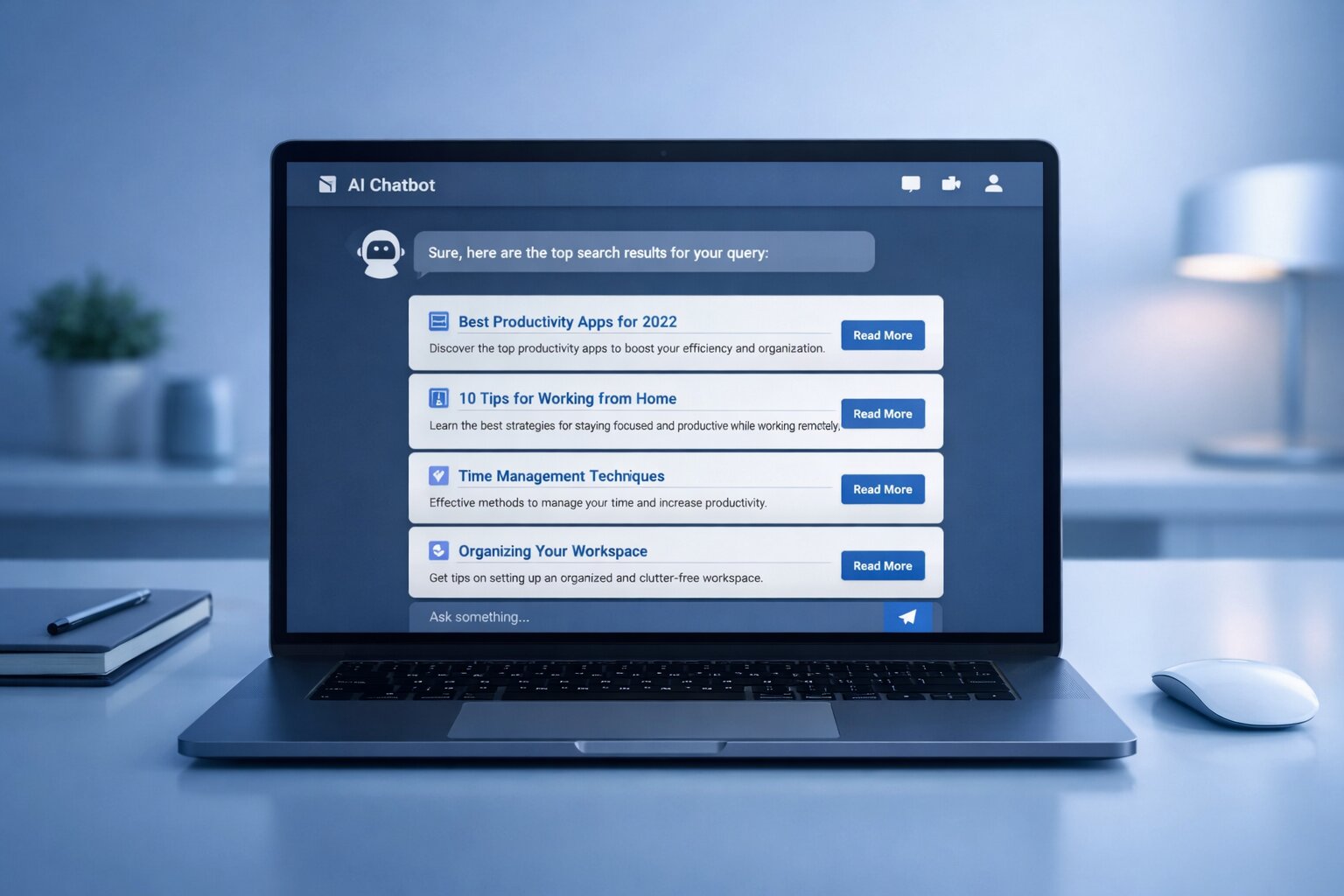
Last Wednesday at Google I/O, Google showed what it plans to do about ChatGPT. It’s called the Search Generative Experience, SGE for short, and it puts an AI-generated answer at the top of the results page, above the links most of us have spent our careers trying to get into.
It isn’t live for everyone. It’s an experiment inside Search Labs, there’s a waitlist, and for now it’s US-only and English-only. I can’t try it from here in the UK without jumping through hoops, so what follows is based on Google’s own demos and the write-ups from US journalists who were shown it around I/O. Take it as a first reaction.
What Google showed
From the demos, the main pieces are:
- An AI snapshot at the top of the page for many queries. A few paragraphs summarising an answer, with links to sources shown alongside it.
- Follow-up questions. You can carry on in a conversational mode, and it keeps the context of what you asked before.
- Shopping results built on Google’s Shopping Graph, so a product query brings back a summary of what to consider plus a list of products with prices, reviews and images.
- Ads still appear, in their own labelled slots, above and below the AI section.
Google was careful to present it as search with AI added, links included, rather than a chatbot. But for a lot of queries the links have moved down the page.
Who should worry
Informational content is the obvious exposure. If someone types “how to clean suede shoes” and gets a decent summary at the top of the page, a meaningful share of them won’t click anything. That has been happening gradually for years with featured snippets. SGE looks like a much bigger version of the same thing.
Comparison and buying-guide content is the second. A query like “best walking boots for wide feet” is exactly the sort of thing Google demoed: a summary of what matters, then a set of products. The affiliate sites and retailer blogs that rank for those queries today are the ones I’d expect to feel it first.
Navigational and branded searches should be fine. Someone searching your brand name wants your site, and I don’t see SGE getting in the way of that.
Where I’m less sure
The source links. In the demos, the snapshot cites a handful of sites. If you’re one of them, maybe you get traffic from people who want more depth, maybe more than you do today from a position-four organic listing. Or maybe hardly anyone clicks the citations at all. Nobody outside Google knows yet, and Google hasn’t shared numbers.
The other unknown is how often the snapshot appears. Google says it won’t show for every query, and that it’s more cautious on topics where accuracy matters most, like health and finance. If it only triggers on a fraction of searches, the impact is smaller than the headlines suggest.
What I’d do about it now
Nothing dramatic. This is an experiment in one country with a waitlist, and Google has a long history of testing things that never roll out widely. But a few sensible moves don’t depend on how it plays out:
- Know which of your organic traffic is informational. Group your Search Console queries by intent. If most of your non-brand clicks come from “how to” and “what is” queries, you have more exposure than a site whose traffic is mainly product and category pages.
- Get your product data in order. If shopping results in SGE come from the Shopping Graph, then a clean, complete Merchant Center feed matters more, not less. Free product listings already pull from it.
- Give people a reason to click. Original photography, real testing, opinions with some weight behind them. Those are the parts a summary has most trouble reproducing.
- Watch brand search. The more people search for you by name, the less it matters what sits at the top of the generic results.
I’ll be watching the US reports over the summer. If SGE starts appearing outside Search Labs, or comes to the UK, I’ll write it up properly.